Messages SMS Text Home
- 3.9
- Rating
- 100.00K
- Installs
- Free
- Price

 Analysis by App-foxy
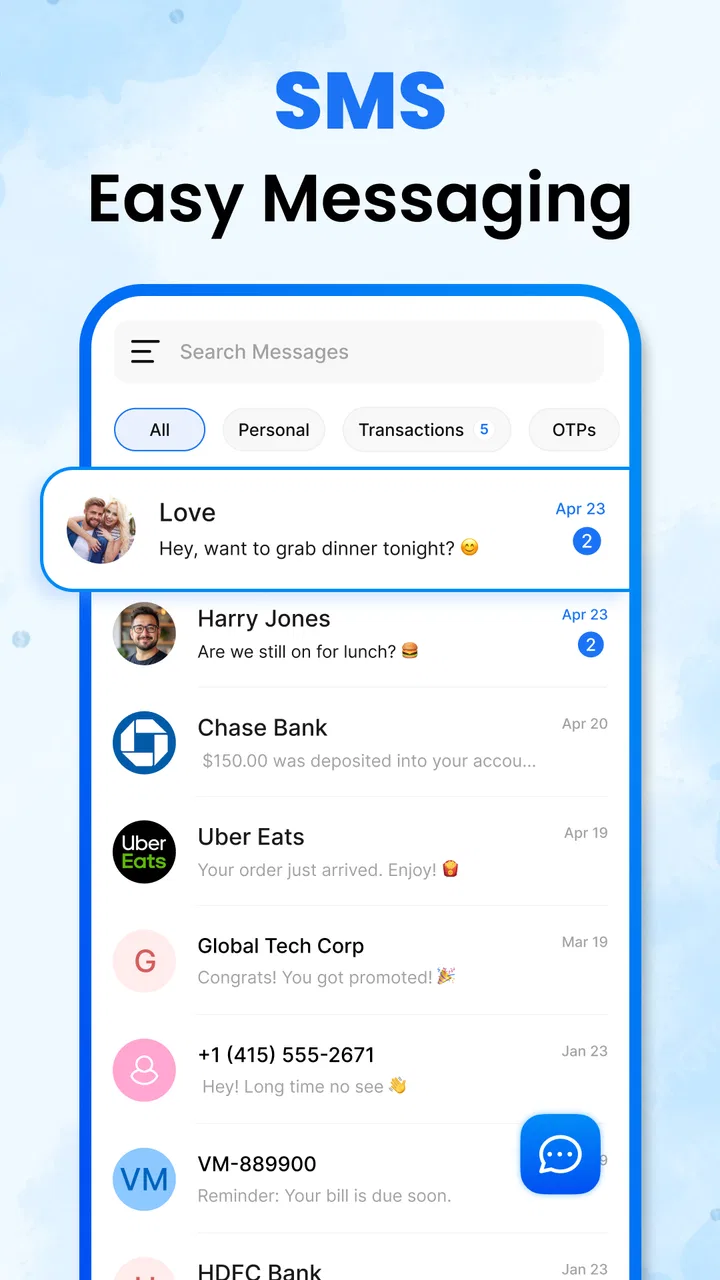
Messages SMS Text Home is a focused communication app from Metamorph AI Labs that puts everyday text messaging at the center of the phone experience. I approached it as someone who wants to reach conversations quickly rather than sort through a crowded collection of features, and that narrow purpose is both its appeal and its main limitation. It is free to install, aimed at Everyone, and currently sits at a 4.2 average from around 130 ratings, with more than 50 thousand installs.
The idea sounds simple: make SMS conversations easy to view and manage from a straightforward home screen. In practice, that can be useful when texting is still the quickest way to contact a delivery driver, family member, school, workplace, or service provider. It also changes how I think about connectivity. The app is not a replacement for a data-heavy chat platform; it is a front door for traditional text communication, where the quality of the experience depends heavily on the phone network, the messaging setup, and the situation in which I am using it.
How Messages SMS Text Home fits into real mobile communication
I look at Messages SMS Text Home as a focused doorway into everyday texting, and this section considers where that approach fits alongside the other ways people communicate on a phone. The useful question is not simply whether SMS is familiar, but whether a dedicated home-screen route makes routine exchanges easier without asking me to change how contacts reach me. From there, I can follow the practical workflow and see where its convenience holds up.
You May Also Like

 Blood Strike: 2.5 Anniversary
Blood Strike’s Loadouts Turn Every Drop Into a Tactical Gamble
A close look at Blood Strike’s custom loadouts: how fast access to signature weapons reshapes its battle royale rhythm, rewards preparation, and narrows the gap between fights.

 Pandora - Music & Podcasts
Pandora’s Music Is Easy to Start, but Harder to Recover
Pandora’s strength is its low-effort path from a seed to a station. Its weak spot is how much confidence it asks you to place in connection, setup, and quiet recovery.

 8 Ball Pool
 Is Built on Rivalries, Rematches, and Routine
A close look at the rivalries, rematches, shared routines, and unanswered safety questions that turn a quick pool match into a persistent mobile community.

 Samsung Music
’s Quiet Strength Is Playing What You Already Own
Its reach comes less from spectacle than from dependable access to a personal library. That simplicity is both the app’s strongest retention engine and its ceiling.

 AccuWeather: Weather Radar
AccuWeather Review: A Quick, Clear Forecast for Everyday Decisions
For everyday plans, the best forecast is the one you can understand quickly. AccuWeather makes rain timing, radar, and local conditions easy to act on, with a few trade-offs.

 Hill Climb Racing
Why Hill Climb Racing Still Turns Crashes Into One More Run
A tiny car, a bumpy hill and one more upgrade: Hill Climb Racing keeps resurfacing because its simple chaos makes every near-miss feel personal.
More From Our News Desk
View All News


A quick route to conversations when the phone is busy
The strongest reason to try this app is convenience. A home-screen-oriented SMS tool makes sense for people who regularly send short messages and do not want to navigate through several layers before finding a conversation. I can imagine using it while walking between appointments, checking a confirmation message before leaving a shop, or replying to a relative while carrying groceries. In those moments, a simple layout matters more than a long list of advanced communication functions.
That simplicity also makes the app easier to understand than a broader social communication platform. Services built around accounts, channels, reactions, media, and group communities can be excellent when everyone involved uses the same service. They are less helpful when the person I need to contact only has a phone number. SMS remains valuable precisely because it reaches ordinary mobile numbers without asking a contact to join another network.
There is an important distinction here: the app gives me a place to view and manage SMS, but it does not turn SMS into an internet messenger. A text conversation still follows the normal realities of mobile messaging. If I am in a weak coverage area, if the recipient cannot receive messages, or if the carrier connection is having trouble, a polished home screen cannot remove that underlying dependency. This is why I see the app as a better access point, not as a new communications network.
What happens when connectivity is part of the experience
Connectivity affects this app in a less obvious way than it affects services such as Signal, WhatsApp, or Messenger. Those platforms usually make the internet connection the center of the conversation. With SMS, the phone network is the practical link between sender and recipient. That can be an advantage when a contact does not share an app with me, but it also means that a message can be delayed by mobile coverage or carrier conditions rather than by the app interface itself.
For that reason, I would not judge Messages SMS Text Home solely by how quickly a conversation opens. The useful question is whether it helps me understand what is already happening with my text messages. When I am connected normally, the home-screen approach should reduce the small amount of friction between unlocking the phone and reaching a thread. When coverage is inconsistent, I still need to pay attention to the message state and avoid assuming that a composed text has reached its destination.
This is one of the app’s practical trade-offs. A dedicated SMS experience can feel more direct than an internet chat service, but it cannot offer the same kind of cross-device flexibility or rich online presence that many modern messaging platforms provide. I would choose it for dependable access to ordinary texting, not for a feature-rich group communication environment.
Useful mobile situations beyond the obvious
One realistic scenario is a day of travel inside a city. I might receive a short pickup instruction, send a change of meeting point, and check a family member’s arrival message while moving through different buildings. A home screen built around SMS keeps those interactions close at hand. The benefit is not that it creates stronger coverage; the benefit is that it reduces the time spent searching for the right conversation while my attention is divided.
Another good use is separating communication habits. Some people use a data-based messenger for close friends but still receive appointment reminders, verification messages, school notices, and business replies through SMS. Having a clear place for those threads can make the phone feel less cluttered. The app is particularly sensible for someone whose communication is mostly short, practical, and number-based rather than media-heavy.
I also see value for users who prefer a smaller learning curve. A relative who does not want to understand several messaging ecosystems may appreciate an interface centered on familiar text conversations. The Everyone age rating supports that broad accessibility, although ease of use still depends on the person’s phone settings and how comfortable they are with changing a default messaging workflow.
On the other hand, people who spend most of their time in internet-based group chats may find little reason to switch. If the important conversations involve voice calls, large media files, reactions, shared communities, or synchronized desktop sessions, a conventional chat platform will usually be more suitable. Messages SMS Text Home is not trying to compete with every communication tool at once, and I would not recommend treating it as one.
Handling weak coverage, delays, and mistaken assumptions
My biggest caution is that a clean interface can create a false sense of certainty. When a message is sent from a familiar home screen, it is tempting to move on immediately. In real life, mobile connectivity is uneven. Underground stations, rural roads, large concrete buildings, and crowded events can all complicate communication. The app can make the conversation easier to reach, but I still need a second plan when the message is time-sensitive.
For urgent situations, I would use a simple recovery habit: check the conversation again after moving into better coverage, look for the current message state, and contact the person through another available method if the timing matters. I would not repeatedly tap send just because the first attempt appears slow. That can create duplicate messages once the network catches up. This small discipline is more important than any visual convenience because the underlying SMS delivery process remains outside the app’s control.
The same applies when a recipient says they did not receive something. I would first confirm the intended number and review the thread before sending again. If the content is important, a short follow-up call may be wiser than filling the conversation with repeated copies. Messages SMS Text Home is useful for organizing the exchange, but it cannot guarantee that every network handoff will behave perfectly.
Recovery also matters when I change phones or reorganize my home screen. Because the app is designed around access and management, I would take a moment to learn where its entry point sits and how it fits alongside the phone’s existing communication tools. The current release is version 1.0.1, so I would approach it as a relatively focused, early-stage experience rather than assume it has the maturity of a long-established messaging suite.
Being sensible with mobile data and messaging costs
SMS and internet messaging are often discussed as if they were interchangeable, but they are not. An internet messenger normally depends on mobile data or Wi-Fi, while SMS is tied to the mobile messaging service. Messages SMS Text Home should therefore be understood as a management layer for text conversations, not as a promise that every communication uses the same connection or carries the same cost implications.
That distinction is useful when traveling. I would avoid assuming that a familiar messaging screen means a message is free everywhere. The app itself is free to download, but carrier terms can still matter for SMS, especially when sending messages internationally or while roaming. Checking the mobile plan is a smarter precaution than relying on the app’s price alone.
The app also includes in-app purchases ranging from $5.99 to $29.99 per item. That makes it important to distinguish between trying the application and paying for optional items inside it. I would begin with the free experience and only consider a purchase after deciding that the app genuinely improves my daily SMS routine. For a basic texting user, any paid option needs to offer a clear practical benefit rather than simply adding complexity to an otherwise direct tool.
When I am trying to conserve mobile data, an SMS-focused workflow can be attractive because ordinary texts are not the same as streaming photos, videos, or voice content through a data-based platform. Still, I would not treat the app as a universal data-saving solution. The relevant behavior depends on what I send, what the phone does in the background, and how the mobile service handles each message. Keeping attachments and unnecessary back-and-forth to a minimum remains the sensible approach.
How it compares with the usual alternatives
The closest alternative is the phone’s built-in messaging experience. That option may be preferable for someone who wants the fewest moving parts and is already comfortable with the default layout. Messages SMS Text Home earns its place when its home-screen emphasis makes conversations faster to reach or easier to manage. If I cannot feel that difference during ordinary use, there is little reason to add another layer.
Internet-based messengers are stronger for rich, ongoing conversations. They commonly suit groups that share the same service and want media, online features, or communication across more than one device. Their weakness is that every participant may need the same app and an active internet path. SMS has the opposite profile: less expressive, but more universal for ordinary phone-number communication.
Dedicated privacy-focused messengers can also be a better choice when the central concern is secure internet communication and all contacts are willing to use that service. I would not select Messages SMS Text Home merely because it looks simple if my priority is advanced privacy tooling, extensive synchronization, or detailed conversation controls. Its value is practical access to SMS, not a complete replacement for every messaging category.
There is also a behavioral comparison. A large social messenger encourages me to remain inside its ecosystem, while this app can keep the purpose narrower: open the text conversation, read the relevant message, respond, and leave. For users trying to reduce app switching and distraction, that restraint may be a genuine strength. For users who want one application to handle every kind of communication, it will feel limited.
Who should install it, and who should pass
I would recommend trying it if most of your important short messages arrive as SMS and you want a more direct route from the home screen to those conversations. It is a reasonable fit for practical communication: appointment changes, family check-ins, work updates, delivery coordination, and other exchanges where the recipient may not share an internet chat app.
I would also consider it for a person who feels overwhelmed by communication apps and wants one focused place for standard texting. The broad Everyone rating and free entry point make it easy to evaluate without committing to a subscription-style service. The developer, Metamorph AI Labs, has kept the product identity clear enough that I know what problem it is meant to solve.
I would skip it if I rarely use SMS, if my contacts are already concentrated in another platform, or if I need extensive multimedia and group features. I would also be cautious if I expect the app to solve weak mobile coverage, guarantee delivery, or replace the capabilities of a full internet messenger. Those expectations would lead to disappointment because the app’s strength is access and organization, not control over the network.
Before settling on it, I would run a small everyday test rather than judge it after opening the first screen. Read a recent thread, reply to a contact, check how naturally you return to the conversation, and notice whether the home-screen arrangement saves time. Then repeat the workflow when you are moving between Wi-Fi and mobile coverage. That test reveals more than a feature checklist because the app’s usefulness depends on how well it fits your actual texting habits.
My connectivity verdict
Messages SMS Text Home makes the most sense as a focused doorway to traditional text messaging. I like the idea of reducing the distance between the home screen and the conversations I actually need, especially during busy mobile moments when searching through a general app feels unnecessary. Its free starting point and clear communication purpose make it easy to consider, while the current 1.0.1 release suggests that I should keep expectations grounded and evaluate the workflow for myself.
The important caveat is connectivity. The app can present SMS in a convenient way, but it cannot make a weak signal strong, turn a delayed message into an immediate one, or provide the rich online environment of a modern chat platform. I would use it with sensible habits: check message status, avoid duplicate sends, remember that carrier terms still apply, and keep another contact method available for urgent matters.
My final view is positive but specific. This is a useful choice for people who want SMS to feel closer and easier to manage, not for people looking for an all-purpose communications suite. If your daily conversations are short, practical, and tied to phone numbers, the focused home-screen approach may remove exactly the friction you notice most. If your communication life is built around internet groups, media sharing, or multi-device messaging, the usual alternatives will probably serve you better.
FAQs for Messages SMS Text Home
01What features does Messages SMS Text Home offer?
Messages SMS Text Home provides a comprehensive suite of messaging features including SMS, MMS, and group chats. Users can also enjoy customizable themes, emojis, and stickers to personalize conversations. Additionally, the app supports advanced search functions for easy message retrieval and quick reply options for efficient communication.
02Is Messages SMS Text Home secure and private?
Yes, Messages SMS Text Home prioritizes user security and privacy. The app uses end-to-end encryption to ensure that your messages are secure from unauthorized access. Additionally, it offers options to lock the app with a PIN or fingerprint authentication, providing another layer of security for your communication.
03Can I use Messages SMS Text Home on both Android and iOS devices?
Messages SMS Text Home is designed for both Android and iOS platforms, making it accessible to a wide range of users. The app offers seamless synchronization across devices, allowing you to switch between them without losing any of your messages or settings. Ensure your device meets the app's system requirements for optimal performance.
04Does Messages SMS Text Home support multimedia messaging?
Absolutely, Messages SMS Text Home supports multimedia messaging, enabling users to send and receive images, videos, and voice notes with ease. The app also allows for the sharing of location and contacts, making it a versatile tool for comprehensive communication. Ensure you have a stable internet connection for sending larger files.
05Are there any in-app purchases or advertisements in Messages SMS Text Home?
Messages SMS Text Home is free to download and use, but it may contain optional in-app purchases for additional themes and sticker packs. The app includes advertisements, but they are designed to be unobtrusive, ensuring they do not detract from the overall user experience. Users can opt to remove ads through a premium subscription.
Pros
- User-friendly interface for quick navigation.
- Supports multimedia sharing with ease.
- Customizable themes and layouts.
- Offline mode for message access.
- Advanced search feature for quick retrieval.
Cons
- Lacks end-to-end encryption.
- No scheduled messaging feature.
- Ad-supported interface can be intrusive.
- Limited integration with other apps.
- Occasional lag on older devices.

Messages SMS Text Home
Gallery